



Our Magazine
The Story Behind the Speedmaster: Why It’s the “Moonwatch”

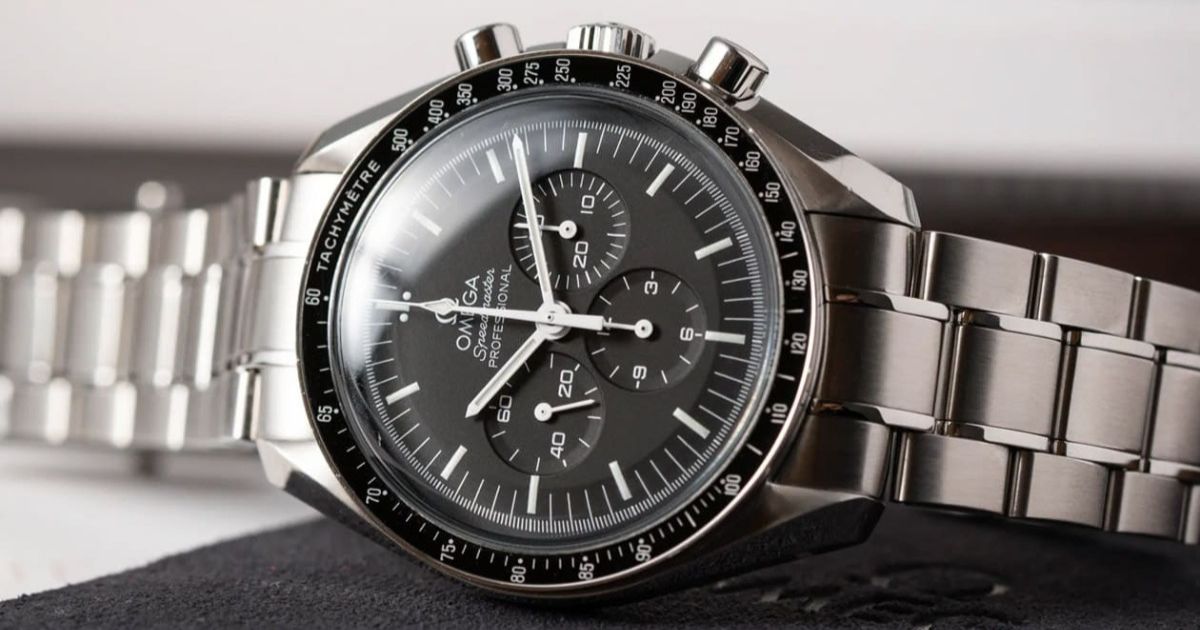
If you spend any time in the world of luxury watches, you’ll hear one name spoken with a particular kind of reverence: the Omega Speedmaster “Moonwatch.” It’s more than just a chronograph; it’s a symbol of human achievement, a piece of engineering that transcended its earthly origins to become a legend. But how did a watch designed for scientists and race car drivers end up on the wrist of an astronaut? The story is a captivating blend of serendipity, rigorous testing, and timeless design.
Let’s rewind to 1957. Omega introduced the Speedmaster as part of its “Professional” line, a trio of tool watches built for specific, demanding tasks. Its siblings were the Seamaster (for divers) and the Railmaster (for engineers). The Speedmaster’s purpose? To be a robust, legible chronograph for motorsports enthusiasts and technicians. Its signature features were all there from the start: the black tachymeter bezel for measuring speed, the highly legible “broad arrow” hands (later changed), and the rugged case. It was a brilliant tool watch, but still earthbound.
The Race to Space and a Fateful Test
As the Space Race heated up in the early 1960s, NASA began quietly searching for equipment that could survive the extreme environment of space. There was no “space watch” category, so they needed to find one that already existed. In 1964, two NASA engineers, unbeknownst to their superiors or the watch companies, walked into a Houston jeweller and purchased a selection of chronographs from various brands off the shelf.
What followed was a brutal, almost sadistic, series of tests designed to break these watches. They were subjected to extremes no human—and certainly no race car driver—would ever encounter:
- Thermal Tests: From -18°C to 93°C in a matter of hours.
- High-Pressure Tests: 1.6 atmospheres of pure oxygen for 48 hours.
- Humidity, Corrosion, and Shock Tests: Simulating violent vibrations and sudden impacts.
- Acceleration and Decompression Tests: Forces up to 16 Gs and near-vacuum conditions.
One by one, the contenders failed. Crystals popped off, hands melted, or movements simply stopped. Only one watch emerged still functioning perfectly: the Omega Speedmaster Professional, reference 105.003.
It wasn’t built for this, yet it passed with flying colours. In March 1965, NASA officially qualified the Omega Speedmaster for all manned space missions. The “Moonwatch” was born, though it hadn’t yet been to the moon.
“The Omega Speedmaster is flight-qualified by NASA for all manned space missions.”
The Speedmaster’s legend was cemented not in a single moment, but through a series of critical missions. In June 1965, during NASA’s Gemini 4 mission, astronaut Ed White performed America’s first spacewalk. Strapped over the bulky sleeve of his spacesuit was his Speedmaster. The images were broadcast worldwide, forever linking Omega with space exploration.
But the true test came during the Apollo 13 mission in 1970. After an oxygen tank exploded, crippling the spacecraft, the crew had to shut down all non-essential power, including their digital timers. To execute a critical, 14-second engine burn for a course correction back to Earth, Commander Jim Lovell used his hand-wound Speedmaster to time the manoeuvre perfectly. Omega later received NASA’s “Silver Snoopy Award” for its role in bringing the astronauts home safely—the ultimate accolade for reliability.
And then, of course, there is July 21, 1969. At 02:56 GMT, Neil Armstrong became the first human to set foot on the lunar surface. His Speedmaster was left in the lunar module as a backup timer (the onboard clock had malfunctioned). Minutes later, Buzz Aldrin joined him, and on his wrist was his Speedmaster Professional. In his own words, it became “the first watch worn on the moon.” That simple statement is the cornerstone of the legend.
The DNA of a Legend: Design That Endures
Beyond the history, the Moonwatch’s enduring appeal lies in its design and mechanics. For learners, understanding these elements is key to appreciating its status.
- The Hesalite Crystal: The Moonwatch famously uses a hesalite (acrylic) crystal, not sapphire. Why? Because in the vacuum of space, if struck, it might crack, but it won’t shutter into dangerous fragments. It’s a purposeful, historical choice.
- The Manual-Wind Movement: The authentic Moonwatch is hand-wound. This was a NASA requirement for reliability (fewer moving parts than an automatic) and because zero gravity means a rotor-powered automatic movement wouldn’t function optimally. Winding it each day creates a tangible connection to the astronauts who did the same.
- The Black Dial and “Dot Over Ninety”: The stark, high-contrast black dial with luminous markers is designed for maximum legibility. Collectors note the “dot over ninety” on the bezel (a small dot next to the 90 on the tachymeter scale) as a hallmark of vintage models, a detail often recreated in modern editions.
- The Case and Pushers: The twisted lugs, the symmetrical case, and the pushers designed to be operated with a gloved hand—every element is functional. After the Apollo 11 mission, Omega even added a small indent to the case near the pushers to accommodate NASA’s newer, thicker spacesuit gloves.
More Than a Watch: A Cultural Icon
The Speedmaster’s journey didn’t end with Apollo. It remained NASA’s official watch for decades, worn on Skylab, for the first Space Shuttle missions, and it is still “flight-qualified” today. It has also become a canvas for incredible storytelling, with special editions commemorating the Apollo missions, the Silver Snoopy award, and other milestones.
So, why is it the Moonwatch? It’s not because it was designed for the moon, but because it proved itself worthy of it. It represents a time when technology was tangible, when survival could depend on the unwavering tick of a mechanical movement. It is a direct, wearable link to humanity’s greatest adventure.
In a world of luxury defined by precious metals and complications, the Speedmaster stands apart. Its value isn’t gem-set; it’s proven. It whispers a powerful story: that with enough courage, precision, and a reliable partner on your wrist, even the moon is within reach.
For the collector or the enthusiast, owning a Moonwatch isn’t just about having a chronograph. It’s about holding a piece of history, an emblem of exploration, and a timeless reminder to always aim for the stars.