



Our Magazine
Depth Gauge Watches: The Most Complex Tool for Divers

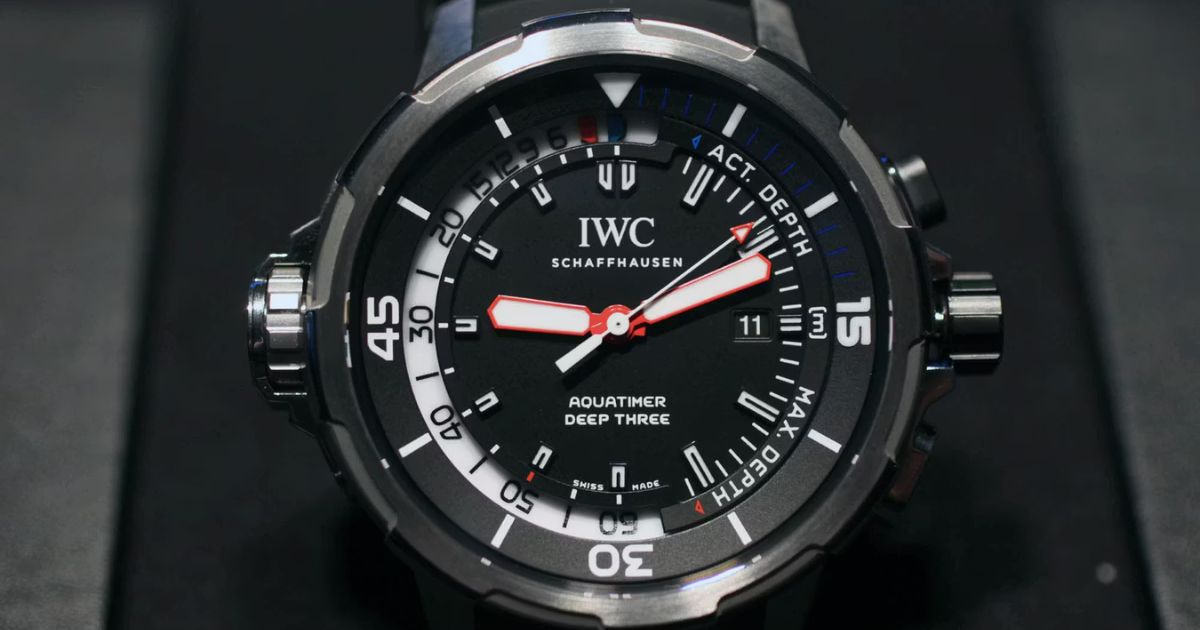
In the exclusive world of luxury dive watches, certain features have become iconic: the unidirectional bezel, the luminous markers, the helium escape valve. Yet, there exists a category within this realm that represents the pinnacle of horological engineering for the aquatic adventurer—the mechanical depth gauge watch. Far more than just a timekeeper, this is an instrument of profound complexity, a wearable piece of oceanographic technology that marries the art of traditional watchmaking with the precise science of pressure measurement. For the discerning collector and the serious diver alike, these watches are the ultimate symbiosis of form and function.
The Principle: How a Mechanical Watch Can Measure Depth
At its core, a depth gauge utilizes a fundamental physical law: water pressure increases with depth. For every 10 meters (approximately 33 feet) of seawater, the pressure increases by one atmosphere. A mechanical depth gauge watch cleverly translates this increasing pressure into a visible measurement on the dial, all without the use of batteries or electronic sensors.
The most common mechanical method involves a porous metal disc or a diaphragm. This component, typically made of a sintered, micro-porous metal, is integrated into the watch case, often under the crown or on the side. As the watch descends, water pressure forces a tiny, measured amount of seawater into a dedicated channel. This water acts on a flexible, airtight membrane (the diaphragm) inside a sealed chamber. The diaphragm expands proportionally to the pressure, which in turn moves a hand on a secondary dial or scale via a delicate series of levers and gears. This hand indicates the current depth. Upon ascent, the water is expelled through the porous material, and the hand returns to zero. It’s a brilliant, self-contained, and entirely analog system.
Engineering Marvels: The Challenges of Integration
Integrating a functional depth gauge into a wristwatch presents monumental challenges for watchmakers. First and foremost is impermeability. The watch must not only protect its movement from water ingress but now also incorporate a system that intentionally allows controlled water interaction in a separate channel. This requires a dual-chamber architecture of incredible precision.
Secondly, the materials science is critical. The porous element must allow water passage at a consistent rate while being utterly resistant to corrosion, salt crystal buildup, and microscopic debris. Materials like sintered titanium or specially treated stainless steel are often used.
Finally, the mechanism itself—the diaphragm, levers, and indicator—must be incredibly sensitive to measure changes of a meter or less, yet robust enough to withstand repeated compression and decompression cycles. Calibrating this system for accuracy across its entire range (often from 0 to 50 or 80 meters) is a feat of micromechanical engineering. The movement that tells the time often shares the case with what is essentially a separate, miniature nautical instrument.
Icons of the Deep: Notable Examples and Their Innovations
Several luxury maisons have risen to this challenge, creating timepieces that are legends in the field.
- IWC Aquatimer Deep Dive III “Deep Gauge”: IWC’s approach was revolutionary. Their system uses a patented pressure ring on the case flank. A yellow indicator hand, driven by the pressure-sensitive ring, points to a depth scale on the outer chapter ring. It’s an exceptionally clear and intuitive display, a hallmark of IWC’s focus on instrumental legibility.
- Jaeger-LeCoultre Master Compressor Diving Pro Geographic: JLC incorporated a depth gauge into its innovative Compressor crown system. Their mechanical membrane gauge, visible through a porthole on the dial, offers a classic instrument-style readout. JLC’s execution is a masterclass in integrating complex functionality without sacrificing aesthetic balance.
- Greubel Forsey GMT Sport with Depth Gauge: This exemplifies haute horology meeting the deep. Greubel Forsey uses a graduated blue sapphire disc on the case side. As depth increases, water enters a channel, and the water’s meniscus line appears against the depth markings on the sapphire. It’s a strikingly elegant and highly legible solution that is as beautiful as it is functional.
- Rolex Sea-Dweller Deepsea Challenge (with Depth Gauge Prototypes): While the production model is an incredible feat of pressure resistance, Rolex has explored functional depth gauges in its history. Some vintage experimental models for professional divers featured external, watch-integrated gauges, highlighting the brand’s deep involvement with saturation diving pioneers.
Beyond the Instrument: The Allure for the Collector
For the luxury watch enthusiast who may never plunge to abyssal depths, the appeal of a depth gauge watch is multifaceted.
- Technical Virtuosity: It represents one of the most tangible examples of a watch as a “complex” in the truest sense. It’s a talking piece that demonstrates a brand’s willingness to tackle an extraordinarily difficult mechanical problem.
- Historical Connection: These watches connect the wearer to the golden age of exploration and diving innovation, when divers relied on robust, mechanical tools. They embody a spirit of adventure.
- Aesthetic Distinction: The depth gauge sub-dial or scale adds a unique, purpose-driven asymmetry to the dial. It’s a detail that immediately identifies the watch as something exceptional within a collection of dive watches.
- Pure Ingenuity: There is an undeniable charm in a device that uses physics, mechanics, and material science to perform a digital function in an analog way. It’s the horological equivalent of a masterfully engineered mechanical calculator.
A Niche Within a Niche
It’s important to note that mechanical depth gauge watches occupy a highly specialized niche. Most professional divers today would use electronic dive computers for their superior accuracy, data logging, and safety features. The mechanical depth gauge watch, therefore, is not about replacing modern technology. Instead, it is a testament to human ingenuity—a celebration of the era when watchmakers solved profound problems with wheels, levers, and springs.
Conclusion: The Pinnacle of the Diver’s Art
In the landscape of luxury dive watches, the mechanical depth gauge stands alone. It transcends the category of a tool watch to become a wearable marvel of micro-engineering. It answers not just the question “What time is it?” but also “Where am I in the vast, pressing volume of the sea?” For the collector, it represents a pinnacle of complication, a piece that speaks of adventure, history, and the relentless pursuit of mechanical solutions to the natural world’s challenges.
Owning one is an acknowledgment that in our digital age, there is still profound value, beauty, and awe to be found in the intricate, physical interaction of metal, water, and pressure—all orchestrated on the wrist. It is, without a doubt, the most complex tool ever devised for the diver, and one of the most fascinating chapters in the story of luxury watchmaking.